




2007 ICC Cricket World Cup Site
ICC Cricket World Cup
Index | Latest News | Results | Related News | Follow the Teams | World Cup Players | World Cup Schedule | CWC Pools & Rules | Venues | Group Standings, Points | Super Eights | World Cup Live TV Broadcasting & Internet Streaming | Mascot & Logo | World Cup 2007 Sitemap | World Cup Facts, History & RecordsICC Cricket World Cup Live Audio Video

Broadcast from 2007 March 13 to April 28
Cricket World Cup on TV, Internet and Mobile Phones
The ICC Cricket World Cup All Inclusive Package $199.95World Cup Cricket Live on TV: Live Broadcasting
TV : All Live Matches, Full Replays, Highlights, Interactive TV Application - Get Dish + Full World Cup Cricket PackageWorld Cup Cricket on Internet: Live Streaming
Internet: Full coverage (limited to one Internet Address), Interactive Highlights, Live audio - Get Dish + Full World Cup Cricket PackageWorld Cup Cricket on Mobile: Live Audio
Mobile: Ball-by-Ball coverage on your mobile phone, Discounted access to unlimited SMS updates - Get Dish + Full World Cup Cricket Package Get All inclusive package + FREE system with DVR & HDTV + FREE install with DishPronto
World Cup Cricket Tournaments
The ICC Cricket World Cup, generally referred to as the Cricket World Cup, is the premier international championship of men's One-day International (ODI) cricket. The event is organised by the sport's governing body, the International Cricket Council (ICC), with preliminary qualification rounds leading up to a finals tournament which is held every four years.ICC Cricket World Cup 2007 web site

- World Cup Cricket 1975 - England
- World Cup Cricket 1979 - England
- World Cup Cricket 1983 - England
- World Cup Cricket 1987 - India & Pakistan
- World Cup Cricket 1992 - Australia & New Zealand
- World Cup Cricket 1996 - India, Pakistan & Sri Lanka
- World Cup Cricket 1999 - England
- World Cup Cricket 2003 - South Africa
- World Cup Cricket 2007 - West Indies
- World Cup Cricket 2011 - Bangladesh, India, Pakistan & Sri Lanka
Prudential World Cup Cricket 1979, England
Dates: 9 June 1979 to 23 June 1979
Teams: England, Australia, New Zealand, West Indies,
India, Pakistan, Srilanka and Canada
Four years later (1975 - first World Cup) the second World Cup was played again in England. For the first time, the 'junior' counties played their own qualifying tournament, a process which saw Sri Lanka and Canada progress to the World Cup proper. The tournament (which was conducted along the same lines as in 1975) was played soon after the 'peace' agreement between the Establishment game and Kerry Packer's breakaway World Series Cricket: things were still rather confused, and West Indies and Pakistan included all their Packer players, while England and Australia did not.
World Cup Cricket 1979
Discuss World Cup 
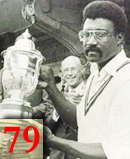
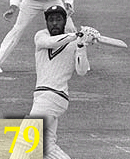
West Indies won the Prudential cup
The second World Cup, officially called The Prudential Cup, proved, like the first in 1975, a great success, and again West Indies carried off the title. Unlike four years earlier, it was not blessed throughout with blissful sunshine during the fortnight it was in progress - June 9 to June 23.
Nevertheless, the three Saturdays provided fine weather and there was only one bad period - June 13, 14, 15 - when not a ball could be bowled in the match between West Indies and Sri Lanka at The Oval. The ground at Old Trafford was also affected, but two days sufficed for England to beat Canada in a low-scoring match.
Again eight countries took part, and from a cricketer's point of view it was a shame that once more South Africa were left in the cold. To fill the two remaining places, a separate tournament was organised among associate members of the International Cricket Conference. From this emerged Sri Lanka, who took part in 1975, and Canada.
The matches were confined to one innings of 60 overs for each side. No bowler was allowed more than twelve overs per innings and the umpires applied strict interpretation in regard to wides and bumpers to prevent negative bowling.
The Prudential Assurance Company put £250,000 in the kitty and the gate receipts from the World Cup came to £359,700, almost double the £188,000 for the first competition. The total attendance last summer was 132,000 compared with 160,000 four years earlier, the drop being almost entirely due to the bad weather. The surplus, distributed to the full and associate members of the International Cricket Conference, came to £350,000.
Prizemoney amounted to £25,900. West Indies, the winners, received the Prudential Cup and £10,000; England, runners-up, £4,000; Pakistan and New Zealand, losing semi-finalists, £2,000 each; and winners of group matches £500 each. There were also Man of the Match awards: £300 to Vivian Richards (West Indies) in the final, £200 each in the semi-finals, and £100 for the nominated player in each group match.
At their meeting which followed the World Cup, the International Cricket Conference agreed to make the competition a four-yearly event with the 1983 tournament again being staged in England. The first World Cup, officially called The Prudential Cup, proved an outstanding success. Blessed by perfect weather, ideal conditions prevailed. Altogether fifteen single innings matches, each confined to 60 overs, were played in England between June 7 and June 21. There were a few one-sided contests among some tremendous and keenly fought struggles. The highlight came in the Final at Lord's where Australia and West Indies were in combat from 11am until 8.45pm when The Duke of Edinburgh presented the Cup to Clive Lloyd, the West Indies captain.
Eight countries took part, but unfortunately not South Africa. The Prudential put £100,000 in the kitty and the overall takings came to more than £200,000 with an aggregate attendance of 158,000. Lord's was packed for the final with 26,000 present and receipts, a record for one day, of £66,000. The winners received £4,000. Australia, runners-up, £2,000 and the losing semi-finalists, England and New Zealand, £1,000 each.
The profits from the competition were distributed: 10 per cent to the United Kingdom and 7½ per cent to each of the seven other participants. The balance went to the inaugurators, the International Cricket Conference, to distribute at their discretion to the non-participating associated member countries, the International coaching fund and the reserve account for the promotion of the next International World Cup.
When the I.C.C. met in London towards the end of June member countries were invited to submit ideas for the next World Cup. India had already said that they were keen to act as hosts, but several members thought it was hard to beat England as the venue.
The main view for this reasoning was the longer period of daylight in England in June when 60 overs for each side can be completed the same day.
Cricket World Cup 1979 Finals Score Board
Discuss World Cup
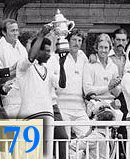
West Indies beat England by 92 runs
Hopes were high for a home win at Lord's in 1979 - but that was before Viv Richards came to the crease.Both sides came into the final with 100% records, but Richards ensured that only the West Indies maintained that status and walked off with their second World Cup.
He strode out with the score on 22 and was still there at the end, hitting a last ball six into the Mound Stand off Mike Hendricks to take the total to 286.
That third six took his own tally to 138 which remains the highest individual score in a World Cup final.
The only other batsman to make a sizeable contribution was Collis King with a barn-storming 86 off 66 balls in a 139-run fifth wicket partnership.
In stark contrast England's batsmen made sedate progress, Mike Brearley and Geoff Boycott putting on 129 runs in 28 overs.
Their pedestrian pace put too much pressure on batsmen further down the order and the match finished in a tumble of wickets as the hosts collapsed from 183 for two to 194 all out, Joel Garner taking five wickets in 11 balls.
West Indies beat England by 92 runs
Man of the Match: IVA Richards
Man of the Match: IVA Richards
England won the toss and
decided to field
|
286 for 9 (60.0 overs) |
|
194 all out (51 overs) |
| Batsman |
|
Runs |
Balls |
4s |
6s |
|
| CG Greenidge | run out | Randall | 9 |
31 | 0 | 0 |
| DL Haynes | c Hendrick | b Old | 20 |
27 | 3 | 0 |
| IVA Richards | not out | 138 |
157 | 11 | 3 | |
| AI Kalicharran | b Hendrick | 4 |
17 | 0 | 0 | |
| CH Lloyd | c&b Old | 13 |
33 | 2 | 0 | |
| CL King | c Randall | b Edmonds | 86 | 66 | 10 | 3 |
| DL Murray | c Gower | b Edmonds | 5 | 9 | 1 | 0 |
| AME Roberts | c Brearley | b Hendrick | 0 | 7 | 0 | 0 |
| J Garner | c Taylor |
b Botham | 0 | 10 | 0 | 0 |
| MA Holding | b Botham | 0 | 6 | |||
| CEH Croft | not out | |
0 |
2 | 0 | 0 |
| Extras | |
1b 10lb | 11 | |
||
| Total | |
for 9 | 286 | |
||
|
|
Live Cricket

|
Batsman |
|
Runs |
Balls |
4s |
6s | |
| JM Brearley | c King | b Holding |
64 |
130 | 7 | 0 |
| G Boycott | c Kallicharran |
b Holding |
57 |
137 | 3 | 0 |
| DW Randall |
b Croft |
15 |
22 | 0 | 0 | |
| GA Gooch | b Garner |
32 |
28 | 4 | 0 | |
| DI Gower |
b Garner |
0 |
4 | 0 | 0 | |
| IT Botham | c Richards |
b Croft |
4 |
3 | 0 | 0 |
| W Larkins | b Garner |
0 |
1 | 0 | 0 | |
| PH Edmonds | not out |
5 |
8 | 0 | 0 | |
| CM Old |
b Garner |
0 |
2 | 0 | 0 | |
| RW Taylor |
c Murray |
b Garner |
0 |
1 | 0 | 0 |
| M Hendrick | b Croft |
0 |
5 | 0 | 0 | |
| Extras |
|
3nb 2w 12lb | 17 |
| ||
| Total |
|
all out | 194 |
| ||
|
|
Live Cricket
Umpires: HD Bird & BJ Meyer.West Indies Team: CG Greenidge, DL Haynes, IVA Richards, AI Kallicharran, CH Lloyd, CL King, DL Murray, AME Roberts, J Garner, MA Holding, CEH Croft.
England Team: JM Brearley, G Boycott, DW Randall, GA Gooch, DI Gower, IT Botham, W Larkins, PH Edmonds, CM Old, RW Taylor, M Hendrick.
Summary of 1979 World Cup
Group A: Canada v Pakistan at Leeds - June 9, 1979
Pakistan won by 8 wickets. Canada 139-9 (60 ov); Pakistan
140-2 (40.1 ov).
Group A: England v Australia at Lord's - June 9, 1979
England won by 6 wickets. Australia 159-9 (60 ov); England
160-4 (47.1 ov).
Group B: India v West Indies at Birmingham - June 9,
1979
West Indies won by 9 wickets. India 190 (53.1 ov); West
Indies 194-1 (51.3 ov).
Group B: New Zealand v Sri Lanka at Nottingham - June
9, 1979
New Zealand won by 9 wickets. Sri Lanka 189 (56.5 ov);
New Zealand 190-1 (47.4 ov).
Group A: Australia v Pakistan at Nottingham - June 13,
1979
Pakistan won by 89 runs. Pakistan 286-7 (60 ov); Australia
197 (57.1 ov).
Group A: England v Canada at Manchester - June 13, 1979
England won by 8 wickets. Canada 45 (40.3 ov); England
46-2 (13.5 ov).
Group B: India vs New Zealand at Leeds - June 13, 1979
New Zealand won by 8 wickets. India 182 (55.5 ov); New
Zealand 183-2 (57 ov).
Group B: Sri Lanka v West Indies at The Oval - June 13,
1979
Match abandoned.
Group A: Australia v Canada at Birmingham - June 16,
1979
Australia won by 7 wickets. Canada 105 (33.2 ov); Australia
106-3 (26 ov).
Group A: England v Pakistan at Leeds - June 16, 1979
England won by 14 runs. England 165-9 (60 ov); Pakistan
151 (56 ov).
Group B: India v Sri Lanka at Manchester - June 16, 1979
Sri Lanka won by 47 runs. Sri Lanka 238-5 (60 ov); India
191 (54.1 ov).
Group B: New Zealand v West Indies at Nottingham - June
16, 1979
West Indies won by 32 runs. West Indies 244-7 (60 ov);
New Zealand 212-9 (60 ov).
Semi-Final: England v New Zealand at Manchester - June
20, 1979
England won by 9 runs. England 221-8 (60 ov); New Zealand
212-9 (60 ov).
Semi-Final: Pakistan v West Indies at The Oval - June
20, 1979
West Indies won by 43 runs. West Indies 293-6 (60 ov);
Pakistan 250 (56.2 ov).
Final: England v West Indies at Lord's - June 23, 1979
West Indies won by 92 runs. West Indies 286-9 (60 ov);
England 194 (51 ov).